

How Microplastics are Reshaping Marine Food Chains
1 minute ago · Updated 1 minute ago

The world’s oceans form one of the most complex and vital life-support systems on Earth. They regulate climate, provide food for billions of people, and sustain intricate ecological networks that have evolved over millions of years. However, this balance is increasingly disrupted by a pervasive and largely invisible pollutant: microplastics. These tiny plastic particles are now altering marine ecosystems at every level, fundamentally transforming how marine food chains function.
This in-depth analysis examines How Microplastics are Reshaping Marine Food Chains, drawing on peer-reviewed research, institutional data, and the latest scientific findings. The goal is to provide a clear, authoritative, and trustworthy overview of a global environmental challenge with far-reaching consequences.
Table
- Understanding Microplastics: Definition and Origins
- The Global Distribution of Microplastics in Marine Environments
- The Foundation of the Food Web: Plankton Under Pressure
- Trophic Transfer and Bioaccumulation
- Physiological and Behavioral Effects on Marine Species
- Disruption of Complex Marine Food Networks
- Microplastics and Coral Reef Ecosystems
- Microplastics as Biological Vectors
- Implications for Human Health
- Advances in Scientific Detection and Monitoring
- Mitigation Strategies and Policy Responses
- The Role of Research, Education, and Public Awareness
- Future Outlook for Marine Ecosystems
- Conclusion
Understanding Microplastics: Definition and Origins
Microplastics are plastic fragments measuring less than 5 millimeters in diameter. They originate from two primary sources. Primary microplastics are intentionally manufactured at small sizes, such as microbeads used in cosmetics, industrial abrasives, or resin pellets. Secondary microplastics result from the breakdown of larger plastic debris due to ultraviolet radiation, mechanical abrasion, and biological degradation.
Once released into the environment, these particles persist for decades, resisting natural decomposition and spreading across marine habitats worldwide.
The Global Distribution of Microplastics in Marine Environments
Scientific surveys have detected microplastics in reshaping marine virtually every marine environment, from coastal waters and estuaries to the deepest ocean trenches. Their distribution is influenced by ocean currents, water density, and particle composition, allowing them to remain suspended in the water column or settle into sediments.
Studies published in leading scientific journals report microplastic contamination in Arctic sea ice, deep-sea sediments, and remote coral reef systems, demonstrating the truly global nature of this pollutant.
The Foundation of the Food Web: Plankton Under Pressure
Planktonic organisms form the base of most marine food chains. Both phytoplankton and zooplankton are highly vulnerable to microplastic exposure due to their small size and feeding mechanisms. Microplastics closely resemble natural food particles, leading to frequent ingestion.
Laboratory and field studies have shown that microplastic ingestion by plankton can result in reduced feeding efficiency, lower energy intake, impaired growth, and decreased reproductive success. These effects cascade upward through the food web, altering energy transfer and population dynamics.
Trophic Transfer and Bioaccumulation
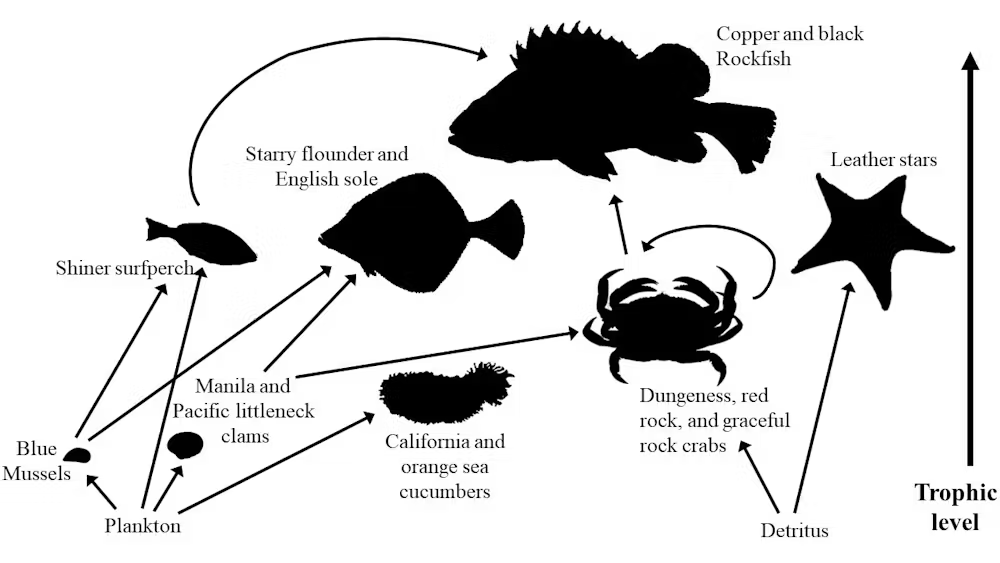
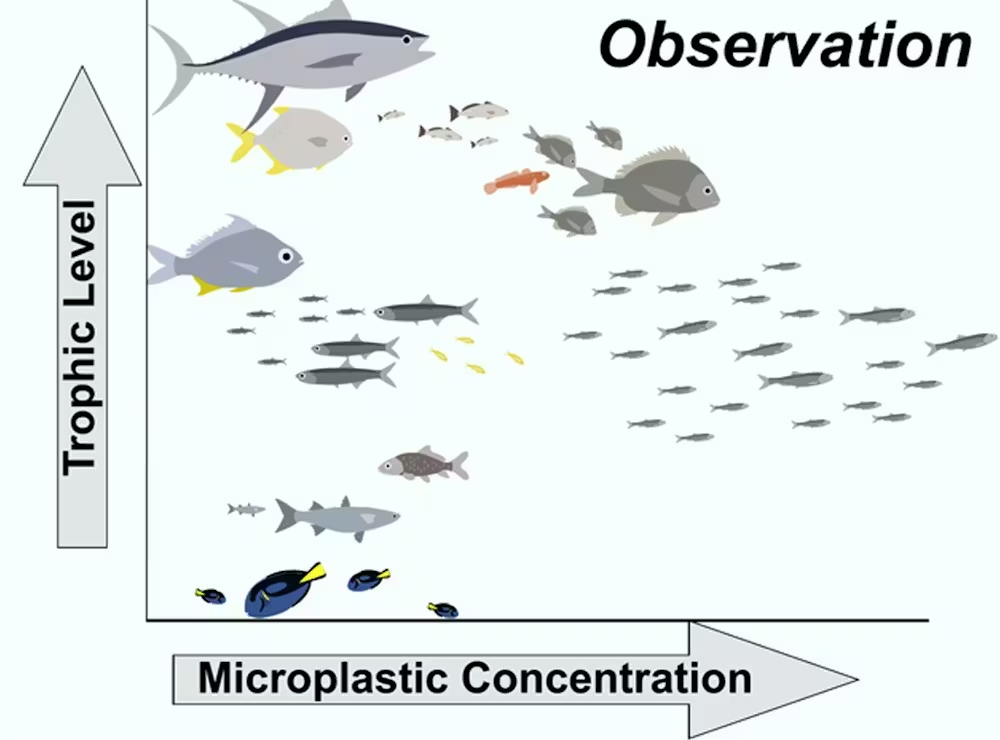
Once microplastics enter the food web, they do not remain confined to lower trophic levels. Small organisms consumed by larger predators transfer both plastic particles and the chemical contaminants they carry. This process, known as trophic transfer, contributes to bioaccumulation within marine species.
Microplastics act as vectors for persistent organic pollutants, heavy metals, and endocrine-disrupting chemicals. As predators consume multiple contaminated prey, these substances concentrate in their tissues, amplifying exposure across successive trophic levels.
Physiological and Behavioral Effects on Marine Species
Research conducted by marine biologists and environmental agencies indicates that microplastic ingestion can disrupt normal physiological functions in fish and invertebrates. Documented effects include intestinal inflammation, oxidative stress, altered metabolism, and compromised immune responses.
Behavioral changes have also been observed. Fish exposed to microplastics may display reduced predator avoidance, impaired foraging behavior, and altered social interactions. Such changes reduce survival rates and affect population stability.
Disruption of Complex Marine Food Networks
Marine food chains reshaping marine are not linear but form complex, interconnected networks. The introduction of microplastics adds a novel stressor that interacts with other environmental pressures such as climate change, ocean acidification, and overfishing.
Scientists have documented shifts in species composition, reduced biodiversity, and altered predator-prey relationships in contaminated ecosystems. These changes weaken ecosystem resilience and compromise the ability of marine environments to recover from disturbances.
Microplastics and Coral Reef Ecosystems
Coral reefs, often referred to as the rainforests of the sea, are particularly vulnerable to microplastic pollution. Corals can ingest microplastics directly or become entangled with plastic debris, increasing susceptibility to disease and physical damage.
Research indicates that microplastic exposure can exacerbate coral bleaching, reduce growth rates, and impair symbiotic relationships essential for reef survival. The degradation of coral reefs has profound implications for marine food chains and coastal communities.
Microplastics as Biological Vectors
Beyond their physical and chemical impacts, microplastics serve as substrates for microbial communities known as the “plastisphere.” These biofilms reshaping marine can host pathogenic bacteria and invasive species, facilitating their transport across vast ocean distances.
This vector function introduces new ecological risks, including the spread of disease and the displacement of native species, further altering marine food web dynamics.
Implications for Human Health
Humans occupy a top position in many marine food chains. As a result, microplastics and associated contaminants consumed by marine organisms can ultimately reach the human diet through seafood consumption.
While research on long-term health effects is ongoing, potential risks include inflammatory responses, cellular stress, and exposure to toxic compounds. International health organizations emphasize the need for precautionary approaches and continued scientific investigation.
Advances in Scientific Detection and Monitoring
Technological progress has significantly improved the ability to detect and analyze microplastics in marine environments. Advanced techniques such as Fourier-transform infrared spectroscopy (FTIR), Raman spectroscopy, and electron microscopy enable precise identification of particle composition and size.
These tools support more accurate risk assessments and strengthen the scientific understanding of how How Microplastics are Reshaping Marine Food Chains at both local and global scales.
Mitigation Strategies and Policy Responses
Addressing microplastic pollution requires coordinated efforts across scientific, industrial, and governmental sectors. Key mitigation strategies include reducing plastic production, improving waste management systems, and developing biodegradable alternatives.
Several countries have implemented bans on microbeads and single-use plastics, while international initiatives aim to establish legally binding agreements to curb plastic pollution globally.
The Role of Research, Education, and Public Awareness
Scientific research plays a central role in informing policy and guiding effective solutions. Equally important is public awareness, which drives behavioral change and supports sustainable consumption patterns.
Educational initiatives that communicate the realities of microplastic pollution help bridge the gap between scientific knowledge and societal action.
Future Outlook for Marine Ecosystems
The continued presence of microplastics in marine environments poses long-term challenges for ocean health. However, growing awareness, technological innovation, and international cooperation offer pathways toward mitigation and recovery.
Understanding How Microplastics are Reshaping Marine Food Chains is essential for safeguarding marine biodiversity, ensuring food security, and preserving the ecological integrity of the oceans for future generations.
Conclusion
Microplastics represent a subtle yet profound threat to marine ecosystems. By infiltrating food chains from their foundation to their apex, these particles disrupt biological processes, alter species interactions, and pose potential risks to human health.
Through rigorous science, evidence-based policy, and collective responsibility, it remains possible to reduce microplastic pollution and restore balance to marine food webs. The health of the oceans is inseparable from the health of the planet and humanity itself.
Si quieres conocer otros artículos parecidos a How Microplastics are Reshaping Marine Food Chains puedes visitar la categoría Environmental Science & Sustainability.
Scientific Outreach: A Comprehensive Guide to Understanding and Communicating Science

The Latest Women Nobel Prize Winners in Science: A Complete and Updated Guide

The Role of AI in Scientific Research: Revolutionizing the Future
What is Environmental Science? A Comprehensive Guide for 2024

The limits of artificial intelligence: What can't machines do yet?

Television as a resource to promote science