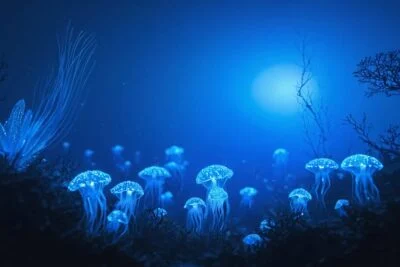
Bioluminescence: Nature’s Underwater Light Shows Explained
In the darkest regions of the ocean, where sunlight cannot penetrate, life has evolved one of the most extraordinary adaptations on Earth: the ability…

Marine biology is the scientific study of life in the oceans and other saltwater environments. Covering more than two-thirds of Earth’s surface, the marine realm hosts an extraordinary diversity of organisms, ranging from microscopic plankton to the largest animals ever known. Marine biology seeks to understand how these organisms live, interact, evolve, and shape the functioning of global ecosystems.
Unlike terrestrial environments, marine systems are structured by depth, pressure, light availability, and chemical gradients. These factors create distinct biological zones, each governed by unique physical and ecological processes. Studying life in the ocean therefore requires an integrated approach combining biology, chemistry, physics, and environmental science.
At Directory of Science, marine biology is explored as a foundational discipline for understanding planetary health, climate regulation, and the future of biodiversity.
The ocean is not a uniform environment but a complex, dynamic system composed of interconnected habitats. Coastal zones, coral reefs, open oceans, and deep-sea environments each support specialized communities adapted to specific conditions.
Marine organisms play essential roles in global biogeochemical cycles. Phytoplankton, for example, drive marine food webs and contribute significantly to oxygen production and carbon sequestration. These processes link marine biology directly to climate science and atmospheric regulation, highlighting the ocean’s influence far beyond its boundaries.
Marine biodiversity reflects hundreds of millions of years of evolutionary adaptation. Life in the ocean has produced a wide range of physiological, behavioral, and reproductive strategies shaped by environmental constraints such as salinity, temperature, and pressure.
From bioluminescent organisms in the deep sea to highly social marine mammals, marine life exhibits adaptations rarely observed on land. Studying these organisms provides insight into evolutionary processes, resilience, and the limits of life under extreme conditions.
Coral reefs are among the most diverse and productive ecosystems on Earth. Built by tiny reef-building organisms, they support complex food webs and provide habitat for countless species. Coastal ecosystems such as mangroves, seagrass meadows, and estuaries act as nurseries for marine life and buffers against coastal erosion.
Marine biology examines how these systems function, how they respond to environmental stress, and why they are particularly vulnerable to changes in temperature, pollution, and ocean chemistry. Their decline has implications not only for biodiversity but also for fisheries, coastal protection, and human livelihoods.
The deep sea remains one of the least explored environments on the planet. Characterized by darkness, extreme pressure, and low temperatures, it hosts organisms adapted to conditions once thought incompatible with life.
Advances in submersible technology and remote sensing have revealed diverse deep-sea ecosystems, including hydrothermal vents where life is supported by chemical energy rather than sunlight. These discoveries challenge traditional assumptions about biological limits and inform research in evolutionary biology and astrobiology.
Marine ecosystems are deeply intertwined with Earth’s climate system. Ocean currents regulate heat distribution, while marine organisms influence carbon storage and nutrient cycling. Changes in temperature, acidity, and oxygen levels directly affect marine species and ecosystem stability.
Marine biology research helps scientists understand how climate change alters species distribution, food webs, and ecosystem resilience. This knowledge is critical for predicting long-term impacts and informing conservation and mitigation strategies.
Human activities increasingly shape marine environments. Overfishing, habitat destruction, pollution, and climate-driven changes exert pressure on ocean ecosystems at multiple scales. Marine biology provides the scientific basis for assessing these impacts and identifying thresholds beyond which recovery becomes difficult.
Pollutants such as plastics, chemicals, and excess nutrients alter marine food webs and organism health. By tracing how these substances move through ecosystems, researchers evaluate risks to biodiversity and human food systems alike.
Marine conservation relies on scientific understanding of species dynamics, habitat connectivity, and ecosystem function. Marine biology informs fisheries management, protected area design, and restoration efforts aimed at sustaining ocean resources.
Effective management balances ecological complexity with social and economic realities. Scientific monitoring and adaptive management approaches allow policies to evolve in response to new data and changing conditions.
Marine biology connects local observations with global processes. Changes in one region can influence ocean circulation, species migration, and ecosystem dynamics elsewhere. This interconnectedness underscores the need for international collaboration in marine research and governance.
As technology expands access to the ocean, marine biology continues to evolve through integration with data science, robotics, and environmental monitoring, enhancing understanding of one of Earth’s most critical systems.
What is marine biology?
Marine biology is the scientific study of organisms living in oceans and saltwater environments and how they interact with their ecosystems.
Why is marine biology important?
It helps explain biodiversity, climate regulation, food systems, and the health of ecosystems that support life on Earth.
What organisms do marine biologists study?
They study a wide range of life, including plankton, algae, invertebrates, fish, marine mammals, and microorganisms.
How does marine biology relate to climate change?
Marine organisms influence carbon cycling and are affected by temperature, acidity, and oxygen changes linked to climate change.
What are coral reefs, and why are they important?
Coral reefs are biologically rich ecosystems that support marine life, protect coastlines, and provide economic and ecological benefits.
Is the deep sea really unexplored?
Yes. Much of the deep ocean remains unmapped and poorly understood due to its extreme conditions.
How do humans impact marine ecosystems?
Through fishing, pollution, habitat alteration, and climate-driven changes that affect ocean chemistry and temperature.
Can marine ecosystems recover from damage?
Recovery is possible in some cases, but it depends on the severity of impact, management practices, and environmental conditions.
1 articles
In the darkest regions of the ocean, where sunlight cannot penetrate, life has evolved one of the most extraordinary adaptations on Earth: the ability…