

How Human Behavior Shapes the Future of Intelligent Systems: Psychology and IA
22 seconds ago · Updated 20 seconds ago

The intersection between psychology and IA is rapidly becoming one of the most influential fields of the digital era. As intelligent algorithms evolve, understanding human behavior, cognition, emotions, and decision-making becomes essential—not only for building more accurate AI systems but also for ensuring they interact ethically and responsibly with society.
Table
- What Is the Relationship Between Psychology and Artificial Intelligence?
- How Psychology Helps Improve Artificial Intelligence
- How Artificial Intelligence Supports Psychological Research
- The Cognitive Foundations of Artificial Intelligence
- Ethical Considerations in the Integration of Psychology and Artificial Intelligence
- Applications of Psychology and IA in Real-World Settings
- Future Trends: The Evolution of Psychology and IA
- FAQs About Psychology and Artificial Intelligence
What Is the Relationship Between Psychology and Artificial Intelligence?
The connection between psychology and IA and artificial intelligence dates back to the origins of computer science. Early AI pioneers—including Alan Turing and Herbert Simon—were inspired by cognitive psychology’s attempts to model thinking. Today, the relationship is even deeper: AI models imitate memory, learning, perception, attention, and even aspects of emotional processing.
AI Inspired by Human Cognition
Many modern AI architectures reflect psychological principles:
- Neural networks are loosely modeled after the brain’s interconnected neurons.
- Reinforcement learning mirrors the behavioral psychology and IA idea of reward-based learning.
- Natural language processing relies on theories of psycholinguistics and language acquisition.
- Computer vision models mimic the psychological mechanisms of visual recognition.
This cross-influence is not accidental; it reflects a growing understanding that replicating or approximating human intelligence requires deep knowledge of how the brain actually works.

How Psychology Helps Improve Artificial Intelligence
1. Better Understanding of Human Behavior
AI systems are increasingly used to interpret and predict human actions—whether in recommendation engines, healthcare diagnostics, or financial risk analysis. Psychology and IA provides the theoretical foundation and empirical data necessary to understand:
- behavioral patterns
- emotional cues
- social interactions
- motivation and preferences
- decision-making processes
When psychological insight is integrated into model design, AI becomes more accurate, more ethical, and more adaptable to real-world conditions.
2. Reducing Bias in Machine Learning
Bias is one of the most urgent challenges in artificial intelligence. Psychology and IA offers decades of research on cognitive biases, stereotype formation, social psychology, and decision errors—insights critical for:
- detecting bias in training data
- designing fairer algorithms
- understanding how humans introduce bias into datasets
- developing debiasing strategies
For example, psychological studies on implicit bias and stereotype threat have directly influenced fairness frameworks used in machine learning today.
3. Human-Centered Design and Ethical AI
Responsible AI aligns with human values and psychological well-being. Using psychological research, designers can create systems that:
- support mental health rather than exploit vulnerabilities
- enhance autonomy and decision quality
- communicate in a trustworthy and transparent manner
- prioritize safety and emotional comfort
This approach reinforces the core principles of trustworthy AI as defined by leading institutions such as the American Psychological Association and academic research found in Google Scholar.
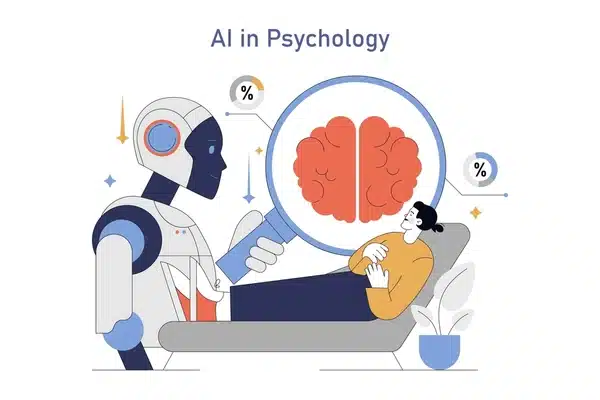
How Artificial Intelligence Supports Psychological Research
While psychology and AI developers understand human behavior, AI also provides new tools to psychologists. Modern machine learning techniques allow researchers to analyze large datasets, identify behavioral patterns, and develop predictive models that were impossible with traditional methods.
1. Big Data and Behavioral Analysis
AI systems can process millions of data points from:
- brain imaging
- clinical notes
- wearable sensors
- social media activity
- digital behavioral traces
These tools enable psychologists to uncover subtle relationships between emotions, habits, and mental states with unprecedented precision.
2. AI-Assisted Diagnosis in Mental Health
AI is increasingly used in clinical psychology and IA to support diagnostic accuracy for conditions such as:
- depression
- anxiety disorders
- bipolar disorder
- PTSD
- neurodevelopmental conditions
Tools such as natural language processing, sentiment analysis, and voice-pattern recognition help clinicians detect early warning signs and personalize treatment plans. Notably, such tools are meant to assist—not replace—human psychologists.
3. Virtual Therapy and Chatbots
Psychological service delivery has expanded with AI-powered platforms, including:
- virtual therapists
- cognitive behavioral therapy chatbots
- mental-health mobile apps
These systems offer accessible support, though they must be carefully supervised by qualified professionals to ensure ethical use.
The Cognitive Foundations of Artificial Intelligence
AI is often described as an attempt to replicate or surpass human intelligence. While modern AI does not truly “understand” the world in a human way, many cognitive principles appear across advanced algorithms.
Machine Learning and Human Learning
Reinforcement learning borrows heavily from behavioral psychology, especially the concept of operant conditioning. Similarly:
- Supervised learning parallels guided instruction.
- Unsupervised learning mirrors pattern discovery and categorization in human cognition.
- Transfer learning reflects how humans apply previous knowledge to new contexts.
Attention Mechanisms and Cognitive Attention
Transformers—the backbone of modern AI models—use “attention” mechanisms that loosely resemble human selective attention. Both systems attempt to allocate processing resources to the most relevant information.
Memory Systems
AI has short-term and long-term storage strategies similar to psychological memory models. Recurrent networks and attention-based architectures can simulate:
- working memory
- episodic recall
- sequential memory
- contextual retrieval
Although not exact replicas, these systems are computational analogs inspired by decades of cognitive research.
Ethical Considerations in the Integration of Psychology and Artificial Intelligence
The fusion of psychology and IA introduces complex ethical challenges. As AI becomes embedded in decision-making systems, psychological vulnerabilities can be exploited—intentionally or unintentionally.
1. Manipulation and Behavior Nudging
AI can learn which psychological triggers influence behavior. This capability raises concerns about:
- hyper-personalized advertising
- digital addiction
- political persuasion
- algorithmic manipulation
Ethical frameworks emphasize transparency, user autonomy, and consent as central protections.
2. Privacy and Mental Data
AI systems that analyze emotions or mental states rely on sensitive psychological information. Protecting such data is essential to prevent misuse in contexts like employment, medicine, or law enforcement.
3. Emotional Artificial Intelligence
Affective computing is capable of detecting emotions from facial expressions, voice tone, or text. While helpful for mental health support, it also raises questions about:
- accuracy
- cultural bias
- misinterpretation
- user consent
Experts recommend human oversight, auditing mechanisms, and strict data-handling protocols.
Applications of Psychology and IA in Real-World Settings
Education
AI-driven learning platforms personalize content based on cognitive science principles, including motivation, memory retention, and learning variability.
Healthcare
Diagnostic assistants, predictive analytics, and therapeutic chatbots are transforming mental health and increasing access to psychological support.
Business and Marketing
Behavioral insights help companies understand user needs, while AI uncovers patterns invisible to traditional analysis methods.
Human–Computer Interaction
Psychology and IA guides the development of intuitive, user-friendly AI interfaces that reduce cognitive load and enhance accessibility.
Future Trends: The Evolution of Psychology and IA
The future of psychology and IA lies in deeper integration, where each field informs and strengthens the other.
1. AI That Understands Human Emotions More Accurately
Next-generation models will analyze multimodal signals—speech, facial expression, physiological data, and language—to achieve a more holistic understanding of emotional states.
2. Personalized AI Assistants
These systems will adjust their behavior to match the user’s personality, habits, cognitive style, and emotional needs.
3. Cognitive Modeling
AI will increasingly simulate human reasoning processes, helping researchers test theories of cognition at scale.
4. Ethical AI Standards
Global organizations are working toward guidelines that integrate psychological research into responsible AI governance.
FAQs About Psychology and Artificial Intelligence
What is the main connection between psychology and IA?
Psychology helps AI understand human cognition and emotion, while AI provides powerful tools for analyzing psychological data.
Can AI replace psychologists?
No. AI assists mental health professionals but cannot provide the nuanced, empathetic, and ethical care that trained psychologists offer.
Is emotional AI reliable?
It can be helpful, but its accuracy varies by context and must be used with caution to avoid misinterpretation.
How is AI useful in mental health?
AI supports early diagnosis, therapy assistance, pattern recognition, and personalized treatment recommendations.
The interaction between psychology and IA represents one of the most transformative scientific frontiers of the twenty-first century. By combining deep insights into human behavior with powerful computational tools, researchers and developers can create systems that are more ethical, more accurate, and more human-centered.
As AI evolves, psychological expertise will remain essential for guiding its development, ensuring fairness, protecting well-being, and fostering a future in which humans and intelligent systems collaborate harmoniously.
Si quieres conocer otros artículos parecidos a How Human Behavior Shapes the Future of Intelligent Systems: Psychology and IA puedes visitar la categoría Psychology & Human Behavior.
The limits of artificial intelligence: What can't machines do yet?

Scientific Outreach: A Comprehensive Guide to Understanding and Communicating Science

What Is Science?

The Skeleton Hand: Anatomy, Functions, and Scientific Curiositie

Artificial intelligence applied: the most surprising examples

What is COVID-19 and how can we prevent it?