

The Skeleton Hand: Anatomy, Functions, and Scientific Curiositie
2 months ago · Updated 48 seconds ago

Table
- Introduction: The Human Hand, Nature’s Masterpiece
- Anatomy of the Skeleton Hand: The Framework of Precision
- The Bones: Carpus, Metacarpus, and Phalanges
- Muscles and Tendons: The Invisible Machinery
- Functions of the Skeleton Hand: Strength, Dexterity, and Sensation
- Scientific Curiosities and Medical Discoveries
- Evolution of the Human Hand: From Tool to Symbol
- Modern Science and Robotics: Replicating the Human Hand
- The Skeleton Hand in Art and Culture
- The Hand as a Mirror of Humanity
Introduction: The Human Hand, Nature’s Masterpiece
Few structures in the human body are as fascinating or as essential as the hand. In “The Skeleton Hand: Anatomy, Functions, and Scientific Curiosities”, we dive deep into the biological engineering and symbolic significance of the hand — a structure capable of both creating art and performing delicate surgery.
Comprising 27 bones, dozens of muscles, tendons, and nerves, the human hand combines strength, precision, and sensitivity. It’s not just a physical tool but also an extension of the mind. According to the National Center for Biotechnology Information (NCBI), the hand’s anatomy evolved to support the complex tasks that define humanity — from crafting tools to expressing emotion through gesture.
Anatomy of the Skeleton Hand: The Framework of Precision
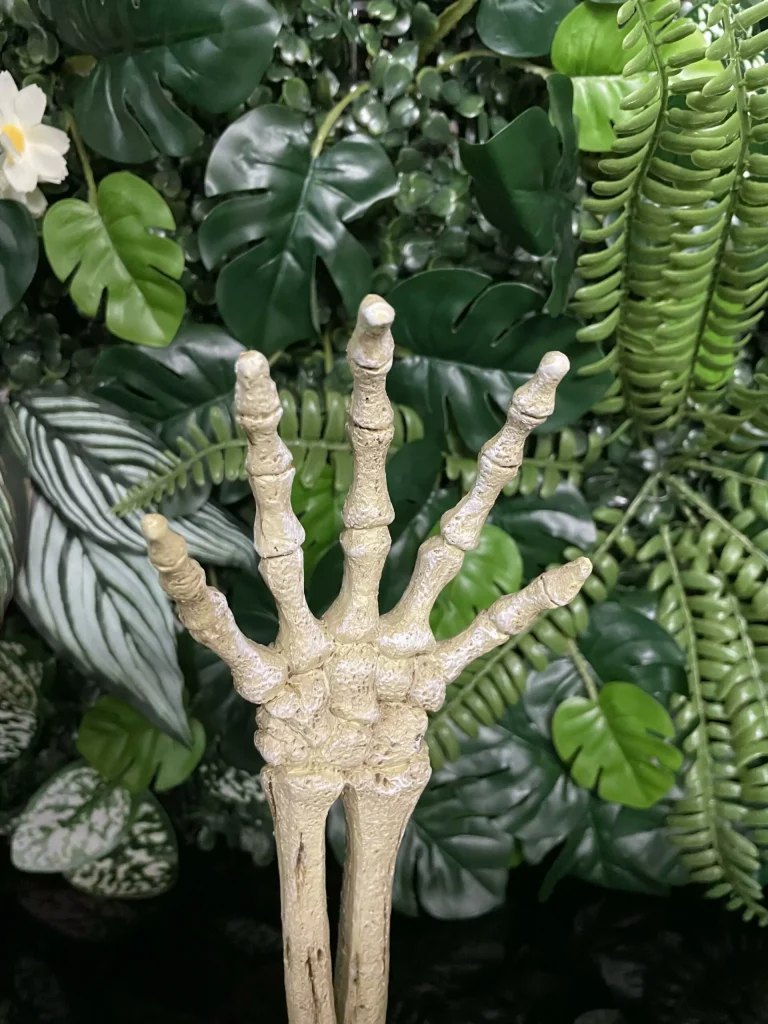
The skeletal hand is divided into three major sections: the carpus (wrist bones), the metacarpus (palm), and the phalanges (fingers). Each part is crucial, providing both structure and mobility.
Eight small carpal bones form the wrist, creating a flexible base that allows for rotation and extension. The five metacarpal bones act as a bridge between the wrist and fingers, while the 14 phalanges give the hand its extraordinary dexterity.
The skeletal system of the hand is also supported by ligaments and tendons that ensure stability. These soft tissues keep the bones aligned while allowing fluid movement — an engineering marvel that mechanical design still struggles to replicate perfectly.
The Bones: Carpus, Metacarpus, and Phalanges
Each region of the hand plays a specific biomechanical role:
- The Carpus (Wrist): Composed of two rows of small bones — scaphoid, lunate, triquetrum, pisiform, trapezium, trapezoid, capitate, and hamate — the carpus enables rotation and stability. These bones form the carpal tunnel, through which crucial nerves and tendons pass.
- The Metacarpus (Palm): Five long metacarpal bones form the skeleton of the palm. They connect the wrist to the fingers, giving support for gripping and movement.
- The Phalanges (Fingers): Each finger contains three phalanges — proximal, middle, and distal — except for the thumb, which has two. This design provides the perfect balance between flexibility and strength.
According to Encyclopedia Britannica, this combination of bone structures allows the human hand to perform fine motor tasks — from writing and playing instruments to threading a needle.
Muscles and Tendons: The Invisible Machinery
Bones provide structure, but muscles and tendons give life to the hand’s motion. The human hand contains intrinsic muscles (within the hand) and extrinsic muscles (originating in the forearm). Together, they allow for gripping, pinching, and subtle manipulation.
Extrinsic muscles, such as the flexor digitorum profundus and extensor digitorum, control the fingers’ major movements. Intrinsic muscles, like the lumbricals and interossei, refine those movements, making gestures and delicate actions possible.
The tendons act as tension cables. When muscles contract, they pull on tendons, which in turn move the bones. A single tendon injury can drastically affect coordination — a fact that medical professionals constantly emphasize when treating hand trauma or repetitive strain injuries.
Functions of the Skeleton Hand: Strength, Dexterity, and Sensation
The human hand is a masterpiece of multifunctionality. It allows us to grasp, touch, create, and communicate. Scientists categorize hand functions into three main groups:
- Power Grips: Such as holding a hammer or lifting weights. These involve the entire hand and forearm muscles.
- Precision Grips: For activities like writing, drawing, or holding a key. This requires coordination between thumb and fingers.
- Sensory Perception: The fingertips are rich in nerve endings, enabling the brain to interpret texture, pressure, and temperature with extraordinary accuracy.
Research from the journal Nature highlights how the hand’s sensory feedback system is critical to fine motor control. Without sensory input, even simple tasks become challenging — a major concern for prosthetic design and rehabilitation medicine.
Scientific Curiosities and Medical Discoveries
The skeleton hand continues to fascinate scientists and doctors alike. For instance, studies of bone density in the metacarpals have revealed insights into age-related diseases like osteoporosis. Researchers also use hand bones to study human evolution — comparing fossilized remains to understand how tool use shaped our anatomy.
Another area of interest is handedness. The dominance of one hand over the other is still not fully understood. Some hypotheses suggest that brain asymmetry and early fetal development play key roles. Interestingly, analysis of prehistoric skeletons indicates that right-handedness has been dominant for tens of thousands of years.
From a medical perspective, the hand’s complexity makes it vulnerable. Conditions like carpal tunnel syndrome, arthritis, and tendonitis can severely impact daily life. Modern surgery and physiotherapy now aim to restore function with remarkable success, thanks to precise anatomical mapping.
Evolution of the Human Hand: From Tool to Symbol
Our ancestors’ hands were crucial to their survival and evolution. The development of opposable thumbs allowed early humans to craft tools, hunt, and manipulate objects — skills that revolutionized human progress. Over time, these physical changes also shaped our cognitive development, linking manual skill with brain expansion.
Anthropologists at the Smithsonian Human Origins Program suggest that the human hand evolved in tandem with language and culture. Gestures likely preceded speech as a form of communication, meaning our hands may have spoken before our mouths ever did.
Symbolically, hands have always represented creation, power, and connection — from prehistoric cave paintings to religious art and modern emojis. The skeleton hand, stripped of flesh, symbolizes both fragility and eternity: the reminder that life’s tools outlast their makers.
Modern Science and Robotics: Replicating the Human Hand
Creating a robotic hand that matches the human hand’s flexibility and sensitivity is one of modern engineering’s greatest challenges. Researchers in robotics and biomechanics have spent decades developing prosthetics that can replicate natural movement and tactile feedback.
Projects like bionic hand prototypes now include pressure sensors, heat detectors, and even artificial skin. These technologies aim to restore autonomy to amputees while offering new insights into how the human hand truly works.
In neuroscience, scientists use brain–computer interfaces (BCIs) to connect prosthetics directly to neural circuits. These systems allow users to control robotic hands through thought — a once science-fiction concept now turning into reality.
The Skeleton Hand in Art and Culture
Beyond anatomy, the skeleton hand carries deep cultural meaning. In art, it often represents mortality, transformation, and the boundary between life and death. Artists from Albrecht Dürer to contemporary tattoo designers use the image of the skeleton hand as a reminder of impermanence.
In popular culture, it appears in everything from gothic jewelry to film imagery — symbolizing rebellion, mystery, or timelessness. The Day of the Dead in Mexico features skeletal hands as part of traditional iconography, blending beauty and decay into a single powerful symbol.
Thus, the skeleton hand is more than a medical structure — it’s a universal metaphor. It speaks to both our fragility and our creative endurance, bridging biology and art in a uniquely human way.
The Hand as a Mirror of Humanity
Through its anatomy, functions, and symbolism, the human hand remains one of the most extraordinary creations in nature. In “The Skeleton Hand: Anatomy, Functions, and Scientific Curiosities”, we see how the study of bones and movement leads to deeper questions about identity, evolution, and expression.
Every gesture we make is the result of millions of years of evolution — an intricate choreography of bone, muscle, and thought. Whether grasping a pen, playing an instrument, or holding another person’s hand, we express the very essence of what it means to be human.
Understanding the skeleton hand, then, is not just an exercise in anatomy — it’s a way to glimpse the deep connection between body, mind, and culture that defines our species.
Si quieres conocer otros artículos parecidos a The Skeleton Hand: Anatomy, Functions, and Scientific Curiositie puedes visitar la categoría Biotechnology & Genetic Research.
The science of color psychology: The Scientific Influence of Color on Human Behavior

The limits of artificial intelligence: What can't machines do yet?

What is COVID-19 and how can we prevent it?

Scientific Outreach: A Comprehensive Guide to Understanding and Communicating Science

The Role of AI in Scientific Research: Revolutionizing the Future

Women in Science: Breaking Barriers and Achieving Excellence