
Predatory Journals Warning Signs: A Verifiable Checklist

5 min read
Predatory journals charge authors but skip real peer review, editing, and indexing. Warning signs include rapid-publication promises, unsolicited invitations, an unverifiable editorial board, and an ISSN or DOI that fails to check out. Before you submit, score the eight red flags below and verify the journal in the ISSN Portal and DOAJ.
In this article
What Is a Predatory Journal?
Predatory journals collect article processing charges (APCs) from authors but skip or fake the peer review, copy editing, and indexing that legitimate journals provide. An APC is the fee some open access journals charge to make an article free to read; the fee itself is not a warning sign. The phrase became common after Jeffrey Beall published lists of questionable publishers in the early 2010s. Many institutions now prefer criteria-based tools such as Think. Check. Submit. because lists can go stale. A 2017 BMC Medicine article by Shamseer and colleagues described distinguishing features that separate legitimate journals from predatory operations. Publishing in a venue that skips peer review is one way research gets distorted online, and authors may not notice until the work becomes hard to cite or find.
Eight Warning Signs to Score Before You Submit
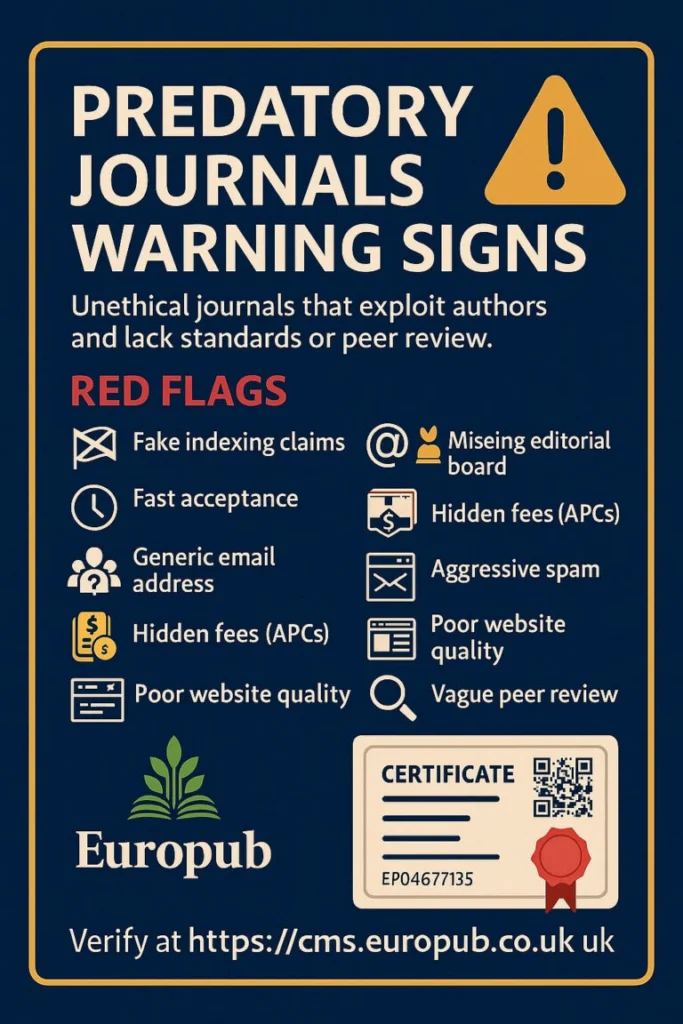
Treat the list below as a scorecard, not a diagnosis. Check each statement that matches the invitation or the journal website. Four or more yes answers are a strong signal to stop and verify the title in the ISSN Portal and DOAJ before submitting.
| # | Warning sign | Yes |
|---|---|---|
| 1 | The journal promises unusually fast review or publication, measured in days rather than weeks. | ☐ |
| 2 | The invitation arrives by unsolicited email with flattering or generic greetings. | ☐ |
| 3 | Editorial board members cannot be confirmed on their own institution or lab pages. | ☐ |
| 4 | The ISSN is missing, invalid, or recorded in the ISSN Portal under a different title. | ☐ |
| 5 | A recent article DOI does not resolve, or resolves to a different journal or article. | ☐ |
| 6 | The journal is absent from DOAJ, OASPA, MEDLINE, Scopus, or Web of Science while claiming broad indexing. | ☐ |
| 7 | The website has repeated spelling errors, broken links, or unclear APC fees. | ☐ |
| 8 | There is no clear retraction, correction, or digital preservation policy. | ☐ |
Count the yes answers. A score of four or more suggests high risk; one or two may reflect a young journal, so verify before assuming. No single sign is decisive by itself, but several together mark a pattern. This threshold turns the checklist into a decision rule: if the score passes four, the safer course is to treat the invitation as low-quality until independent records prove otherwise.
How to Verify a Journal’s ISSN, DOI and Indexing
Start with the identifiers, because they are the easiest claims to test. The same verification standard also appears in work on how scientific claims are checked.
- Look up the ISSN in the ISSN Portal. The portal records an 8-digit code for continuing resources such as journals, magazines, and newspapers. A legitimate record shows the title, country, medium, and publisher; compare each field with the journal’s own site. It also links to ROAD, which lists open access scholarly resources, and the Keepers Registry for archiving status. A mismatch between the site and the portal is a red flag.
- Resolve a recent article DOI at Crossref. Crossref runs open infrastructure that links research objects and supports metadata exchange; members register around 37,000 records daily. The registration record should match the article title and journal name. If the DOI does not resolve or points elsewhere, the journal may not be registering its content.
- Check DOAJ for open access titles. DOAJ lists journals that meet its criteria for legitimate open access publishing. Absence from DOAJ is not proof of predatory behavior because a new journal may not yet meet all criteria, but it removes one independent check.
- Search subject and citation databases such as MEDLINE, Scopus, or Web of Science. A journal that claims indexing should appear in the database’s coverage list. Compare the claimed indexing against the database’s official title list; if it does not appear, treat the claim as unverified.
Ukrainian readers can check research information resources at UkrISTEI (посилання).
If You Already Published: What to Do Next
Finding a warning sign after acceptance does not mean the work is lost. COPE guidance on retractions and corrections helps authors and editors decide when withdrawal is appropriate. Authors can take several steps to limit the damage:
- Gather the evidence: the invitation, fee invoices, reviewer reports, and the DOI or ISSN checks.
- Request retraction or withdrawal in writing, citing the specific checks that failed.
- Notify co-authors and the institution’s research office so the record is corrected in one place.
- Preserve all correspondence and payment records; they may be needed for an institutional complaint.
- Check the original publication agreement before submitting the work elsewhere.
A retraction is a formal correction, not an erasure; it signals that the record has been reviewed.
Legitimate Open Access vs. Predatory: Quick Comparison
A legitimate open access journal can charge a fee; the difference is what the fee buys.
| Indicator | Legitimate open access | Warning sign |
|---|---|---|
| Peer review | Documented and completed | Promised in days, with no reviewer details |
| Editorial board | Real researchers, verifiable | Unverifiable or copied names |
| ISSN and DOI | Registered and resolving | Missing, mismatched, or dead |
| Indexing | DOAJ, OASPA, or recognized databases | Claims impact factor without coverage |
| Fees | Clear APC, sometimes waived | Vague or hidden until acceptance |
| Corrections | Published retraction policy | No policy or contact |
Clear retraction and correction policies are a practical test of whether a journal treats publication as responsible science communication.
Frequently Asked Questions
Are all open access journals predatory? No. Legitimate open access journals use peer review, editorial oversight, and indexing, and they appear in DOAJ or OASPA. The APC is a business model, not a warning sign by itself.
How can I tell if a journal is predatory? Score eight red flags—rapid publication promises, unsolicited email, unverifiable editorial board, missing ISSN or DOI—then verify the title in the ISSN Portal and DOAJ.
Does a high impact factor prove a journal is safe? No. Impact factors can be faked or bought. Verify the ISSN, DOI resolution, and indexing record before relying on any metric.
What should I do if I already published in a predatory journal? Request retraction with evidence, notify co-authors and your institution, and keep all correspondence and payment records.
Sources: Think. Check. Submit.; ISSN Portal; Crossref; DOAJ; COPE; Shamseer et al. 2017, BMC Medicine.
Si quieres conocer otros artículos parecidos a Predatory Journals Warning Signs: A Verifiable Checklist puedes visitar la categoría Science & Society.


Keep reading