How to Find Peer-Reviewed Journals: A Practical Checklist

5 min read
A peer-reviewed journal publishes articles that independent experts have evaluated before acceptance. To find one, start with a disciplinary database or Google Scholar, then verify the journal by its ISSN in the ISSN Portal or DOAJ. Free routes include DOAJ, PubMed Central, CORE and Unpaywall; no library subscription is required.
In this article
What Is a Peer-Reviewed Journal?
Peer-reviewed journal articles are papers that independent researchers in the same field have evaluated before publication. Reviewers check methods, evidence and fit with the journal's scope. A scholarly source usually names an editorial board, cites prior work and reports its peer-review status. Peer review filters for quality, but it does not guarantee that every conclusion is correct. Also check sample sizes, dates and funding statements when relevant. Some journals publish entirely open access, while others mix free and subscription content. Trade magazines and news outlets may cover studies, but they do not subject submissions to this independent review.
Start With a Library Database or Google Scholar
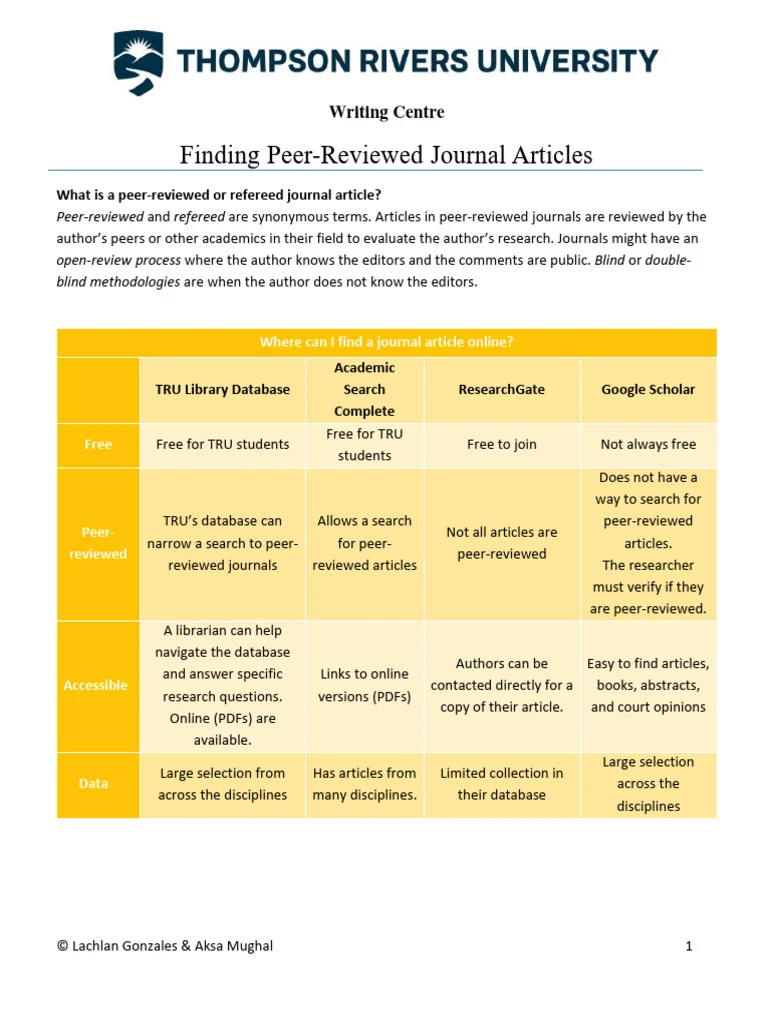
How to find peer-reviewed articles on Google Scholar begins with knowing what the service does not filter. A library database usually offers a "peer-reviewed" or "scholarly" limiter; Google Scholar does not. Public access does not always mean peer-reviewed status; the two must be checked separately.
Library databases: how to filter
Library databases let readers filter results by peer-reviewed journals or scholarly sources. Disciplinary choices include PubMed for biomedical literature, and field-specific databases for physics, education and other subjects. Many public libraries provide remote access to general databases, though their catalogs differ by region. A marine-biology question can be approached through these tools; our explainer on marine food chains offers one example. If the limiter is missing, search the journal title in the ISSN Portal or DOAJ after reading the abstract.
Google Scholar: wide but not sufficient
Google Scholar indexes many peer-reviewed journal articles but also books, theses, court opinions and preprints. It has no peer-review filter. Treat it as a discovery layer: find a title, then verify the journal through its ISSN or DOAJ record. Citation chaining—following references forward and backward—works well in Scholar, and the "All versions" link can reveal a free repository copy.
Verify a Journal for Free Without a Subscription
Three free checks turn a suspicious title into a verifiable journal.
Check the ISSN
The International Standard Serial Number is an 8-digit code used to identify continuing resources, including journals, magazines and periodicals in any medium. The ISSN Portal lists more than two million serial publications with trusted identifiers, and its basic search is free. Enter the journal's ISSN or title to see the matching record. A missing or mismatched record is a warning sign.
Look it up in DOAJ
The Directory of Open Access Journals (DOAJ) is a free index of open access journals. Basic lookups do not require a subscription. Search by title or ISSN; a DOAJ listing means the journal has met its criteria for open access. If the journal is not listed, that alone is not proof of a problem, but combine it with other checks.
Apply Think. Check. Submit.
Think. Check. Submit. offers checklists for journals, and for books and chapters. Its questions cover journal scope, editorial board and publication fees. Use the journal checklist only if you can answer yes to its questions. The initiative is led by ALPSP, AUP, COPE, DOAJ, ISSN, LIBER, OAPEN, OASPA, STM and UKSG. It focuses on trust, integrity and practical assessment before submission.
Where to Read Peer-Reviewed Articles Without a Subscription
A peer-reviewed articles database is not the only route. Several free archives and aggregators provide legal access, and the four below cover different fields.
Free open-access repositories
PubMed Central is a free full-text archive of biomedical and life sciences journal literature at the U.S. National Institutes of Health's National Library of Medicine; it holds 12.6 million articles. DOAJ links to journals that publish open access. CORE aggregates open-access papers from repositories around the world, and Unpaywall finds legal open-access copies by DOI. Search by article title or DOI rather than by journal alone. For a health-science example, see our COVID-19 explainer. A free archive can also hold the papers behind a major result, such as the observations that moved black holes from theory to first image.
Preprints: not peer-reviewed
Preprints are author manuscripts posted before formal peer review. Preprint servers label them clearly, and "preprint (not yet peer-reviewed)" is the key marker. Treat them as early findings, not as established conclusions. A preprint server may host early versions that never complete peer review.
How to Spot a Predatory Journal
Predatory journals imitate legitimate titles while cutting corners on peer review and fee transparency. Think. Check. Submit. encourages researchers to ask practical questions before submitting.
| Signal | Why it matters |
|---|---|
| No valid ISSN or a mismatched ISSN record | The ISSN Portal shows no matching title or publisher. |
| Promises of unusually fast review | Peer review normally takes weeks or months, not days. |
| Fees that are vague or requested before acceptance | Transparent journals separate submission fees from publication costs. |
| No named editorial board or unverifiable members | A credible journal lists editors with real affiliations. |
| Aggressive email invitations outside the field | Predatory publishers often mass-mail researchers. |
Step-by-Step Checklist
- Search a disciplinary database or Google Scholar and note the journal title.
- Copy the journal's ISSN from its website or article page.
- Enter the ISSN or title in the ISSN Portal to confirm the record.
- Look up the journal in DOAJ and complete the Think. Check. Submit. checklist.
- Open the article through DOAJ, PubMed Central, CORE or Unpaywall before sharing it.
These steps can be completed from a public computer with no library login.
Frequently Asked Questions
What is a peer-reviewed journal?
It is a journal whose submissions are evaluated by independent experts before acceptance; it is not just any scholarly-looking platform.
Is JSTOR a reliable source?
JSTOR is a reliable archive, but it includes editorials, book reviews and primary sources that are not peer-reviewed; check the item type.
What are the top 5 academic search engines?
Google Scholar, PubMed, Scopus, Web of Science and Semantic Scholar; verify results against the journal's ISSN or DOAJ because no engine is a guaranteed peer-review filter.
Where can I read peer-reviewed articles for free?
DOAJ, PubMed Central, CORE and Unpaywall; use the DOI or title to find legal open-access versions.
How do I know if a journal is predatory?
Use Think. Check. Submit., DOAJ and the ISSN Portal; missing ISSN, unrealistic promises and high or vague fees are red flags.
Sources
- Directory of Open Access Journals (DOAJ)
- Think. Check. Submit.
- ISSN Portal
- PubMed Central (PMC)
Si quieres conocer otros artículos parecidos a How to Find Peer-Reviewed Journals: A Practical Checklist puedes visitar la categoría Science & Society.

Keep reading