

What Is Peer Review?

7 min read
Peer review is the process in which a journal editor asks independent researchers in the same field to judge a manuscript's methods, evidence, and conclusions before publication. It is a quality check, not a proof of truth; reviewers recommend acceptance, revision, or rejection, and the editor makes the final call.
In this article
- What is peer review and who are the peers?
- What do reviewers check?
- Types of peer review: a table
- The process from submission to decision
- A real-world example of review comments
- Research article vs peer-reviewed article
- Does peer-reviewed mean trustworthy? How to check
- Peer review across fields
- FAQ
- Sources
What is peer review and who are the peers?
In academic publishing, peer review is the evaluation of a manuscript by independent researchers with expertise in the same subject area. The ICMJE Recommendations describe peer reviewers as professionals with relevant expertise who advise the editor, while the editor retains final responsibility for publication decisions. Journals typically invite two or three reviewers per manuscript, though the number can vary by field and journal policy. Reviewers assess whether the work is original, whether the methods support the conclusions, and whether ethical issues are disclosed. Peer review does not repeat every experiment or guarantee that the findings are correct. It is a structured check that helps editors decide what merits publication and what should be revised or rejected. Reviewers often work on a volunteer basis, and their reports are usually shared with authors in anonymous or signed form depending on the model. The term "peers" does not mean personal friends; it means researchers qualified to judge the work. An editor may also invite a statistical reviewer when the analysis is complex.
What do reviewers check?
Reviewers generally examine originality, methodology, ethical compliance, and clarity, according to the COPE Ethical Guidelines for Peer Reviewers. They look for gaps in the analysis, unsupported claims, missing citations, and conflicts of interest. They do not usually reproduce the data or guarantee that a paper is true. Even a reviewed paper can later be retracted if errors or misconduct surface. Reviewers advise the editor; they do not decide alone. COPE also asks reviewers to treat manuscripts as confidential and to complete their work within the journal's timeline. A reviewer's role is therefore narrower than a public stamp of approval. When a reviewer suspects plagiarism or data fabrication, the journal may investigate before or after publication. Some journals also ask reviewers to score novelty and significance, but those judgments can vary. Journals increasingly experiment with automated screening and large-scale checks; those tools can carry their own bias in algorithmic decisions, which editors must weigh.
Types of peer review: a table
Journals choose among four main models, with different visibility and risk of bias. In single-blind review, the reviewer knows the authors, but the authors do not know the reviewer. In double-blind review, neither side knows the other's identity. Open review makes one or both identities visible, sometimes publishing the review reports. Post-publication review places the article online first and invites comments after publication. The table below summarizes the differences.
| Type | Reviewer sees author? | Author sees reviewer? | Typical context |
|---|---|---|---|
| Single-blind | Yes | No | Common in science and medicine |
| Double-blind | No | No | Common in social sciences and humanities |
| Open | Yes | Yes, often | Journals that publish review reports |
| Post-publication | Not applicable; article is public | Varies | Preprints and some online platforms |
The ICMJE Recommendations and COPE describe these models and leave the choice to each journal. No model removes all bias; double-blind review can reduce author prestige effects, but reviewers may still guess the author from the writing or the references. Journals also set rules about conflicts of interest and reviewer deadlines for each model.
The process from submission to decision
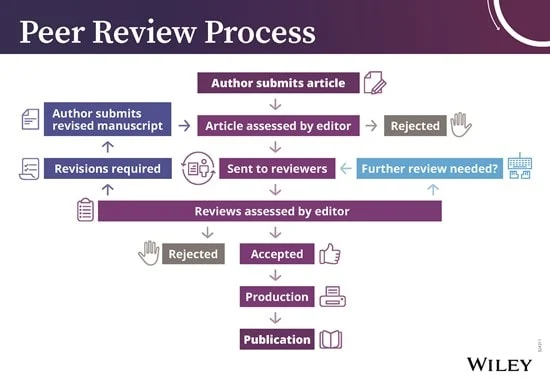
After a manuscript is submitted, an editor first checks whether it fits the journal's scope and basic standards. Many submissions are rejected at this stage without external review, sometimes called a desk rejection. The editor then invites reviewers and sets a deadline. Reviewers return comments and a recommendation, usually one of accept, minor revision, major revision, or reject. The editor weighs the reports and makes the final decision. If revision is requested, authors respond point by point and the paper may go back to reviewers. The total time varies widely by field and journal; some decisions take weeks, others take months. Authors can ask the journal's editorial office about typical timelines. Throughout this process, scientific publication does not automatically settle a debate; when scientific evidence fails to convince is a separate question. For engineering and applied-science journals, the same sequence applies, from initial screening to a final accept or reject decision. A revision is not a rejection: it means the editor sees enough value to give authors a chance to improve the paper. Desk rejections often happen for reasons unrelated to quality, such as scope mismatch.
A real-world example of review comments
Consider a hypothetical manuscript that reports a new sensor calibration method for an engineering instrument. The decision letter and reviewer comments below follow standard reviewer report sections; they are not drawn from any real paper. In single-blind and double-blind review, the comments are usually structured in the same way: a summary, then major points, then minor points. The tone can vary, but the substantive questions are about methods, data, and interpretation.
Decision letter: Major revision. Reviewer 1 recommends revision; Reviewer 2 raises concerns about reproducibility. Please respond point by point and resubmit within 60 days.
Reviewer comments, summary: The method is clearly described and the topic fits the journal, but the results do not yet rule out a simpler explanation.
Major issue 1: The calibration setup is underspecified. Add a diagram and state temperature and humidity during each run.
Major issue 2: The error analysis combines systematic and random errors. Report them separately with confidence intervals.
Minor issue: Table 2 labels the units inconsistently; unify to SI units.
This example shows what “major revision” looks like in practice: the editor asks for changes, and the authors get a chance to respond rather than being rejected outright. Reviewers usually prioritize methodological concerns over style, and authors reply with a letter that lists each change. A reviewer report does not need to be hostile to be rigorous; the questions above are typical. The hypothetical decision reflects the editor's judgment after reading both reports.
Research article vs peer-reviewed article
A research article reports original findings; a peer-reviewed article has passed expert review before publication. Not everything in a peer-reviewed journal is peer-reviewed: editorials, letters, book reviews, and corrections are usually reviewed only by editors. The distinction matters because a reader may find an editorial in a peer-reviewed journal and assume it has been externally reviewed, which is often not the case.
| Research article | Peer-reviewed article |
|---|---|
| Reports original data, methods, results, and conclusions | Has passed independent expert review before publication |
| Often includes abstract, introduction, methods, results, and discussion | May be a research article, review, or other type the journal labels peer-reviewed |
| May appear as a preprint before review | Not all items in a peer-reviewed journal are peer-reviewed |
To check the status of a specific article, look at the article type and the journal's peer-review policy.
Does peer-reviewed mean trustworthy? How to check
Peer review raises credibility but does not guarantee correctness. Reviewed papers can still contain errors, selective reporting, or fraud. The PubMed record for an article shows whether it appears in the indexed literature, and Crossref confirms its DOI and publisher metadata. The Directory of Open Access Journals lists open-access titles with editorial-quality criteria, and Retraction Watch tracks post-publication notices. A peer-reviewed label is a useful signal, not a final verdict. Readers can also check the journal's editorial policy directly. No single database captures all quality problems, but combining these checks makes it easier to spot questionable papers. PubMed covers biomedical literature, so for engineering or accounting journals, Crossref and the publisher's policy are more relevant. What happens after publication matters too, as how science travels on social media can amplify or distort findings.
Peer review across fields
Peer review follows the same basic principles across disciplines, but field-specific databases help readers confirm a journal's status. In psychology, PsycINFO indexes peer-reviewed material; in nursing and health, CINAHL and PubMed do the same. Accounting and engineering journals apply similar editorial checks, though terms and timelines differ. A psychology study may use double-blind review more often than an engineering lab report, while nursing journals may require additional ethics review. The core test is the same: independent experts judge the methods and conclusions before publication. The same logic applies to whether psychology is a science, where peer review is one of several markers of scientific practice. These databases do not replace the journal's policy, but they help readers confirm whether a journal follows a recognized review process.
FAQ
What does "reviewing" mean?
A qualified researcher reads and judges a manuscript's design, data, and conclusions, usually for a journal editor.
Who are the peers in a peer review?
Peers are independent researchers with expertise in the same subject area, typically two or three per manuscript, chosen by the editor.
What is the difference between a research article and a peer-reviewed article?
A research article reports original findings; a peer-reviewed article has passed expert review before publication, but not every item in a peer-reviewed journal is peer-reviewed.
Does peer-reviewed mean trustworthy?
No; peer review raises credibility but does not guarantee correctness, and reviewed papers can still contain errors or fraud.
Sources
- ICMJE Recommendations
- COPE Ethical Guidelines for Peer Reviewers
- PubMed
- Crossref Metadata Search
Si quieres conocer otros artículos parecidos a What Is Peer Review? puedes visitar la categoría Science & Society.


Keep reading