

Bioluminescence: Nature’s Underwater Light Shows Explained
6 seconds ago · Updated 4 seconds ago

In the darkest regions of the ocean, where sunlight cannot penetrate, life has evolved one of the most extraordinary adaptations on Earth: the ability to produce light. From glowing waves along coastlines to deep-sea creatures emitting flashes of blue and green, bioluminescence transforms the ocean into a living light show. This phenomenon is not only visually stunning but also biologically and ecologically significant.
This article explores Bioluminescence: Nature’s Underwater Light Shows Explained, examining how and why marine organisms generate light, the evolutionary advantages it provides, and what scientists have learned about its role in ocean ecosystems.
Table
- What Is Bioluminescence?
- The Chemistry Behind Living Light
- Where Bioluminescence Occurs in the Ocean
- Bioluminescent Plankton: The Ocean’s Sparkle
- Deep-Sea Bioluminescent Creatures
- Counterillumination: Hiding in Plain Sight
- Communication Through Light
- Defense Mechanisms and Predator Avoidance
- Bioluminescence and the Marine Food Web
- Evolutionary Origins of Bioluminescence
- Human Encounters With Bioluminescence
- Scientific Applications and Research
- Bioluminescence and Climate Change
- Challenges in Studying Bioluminescence
- What Bioluminescence Teaches Us About Life in the Ocean
- The Future of Bioluminescence Research
- Conclusion
What Is Bioluminescence?
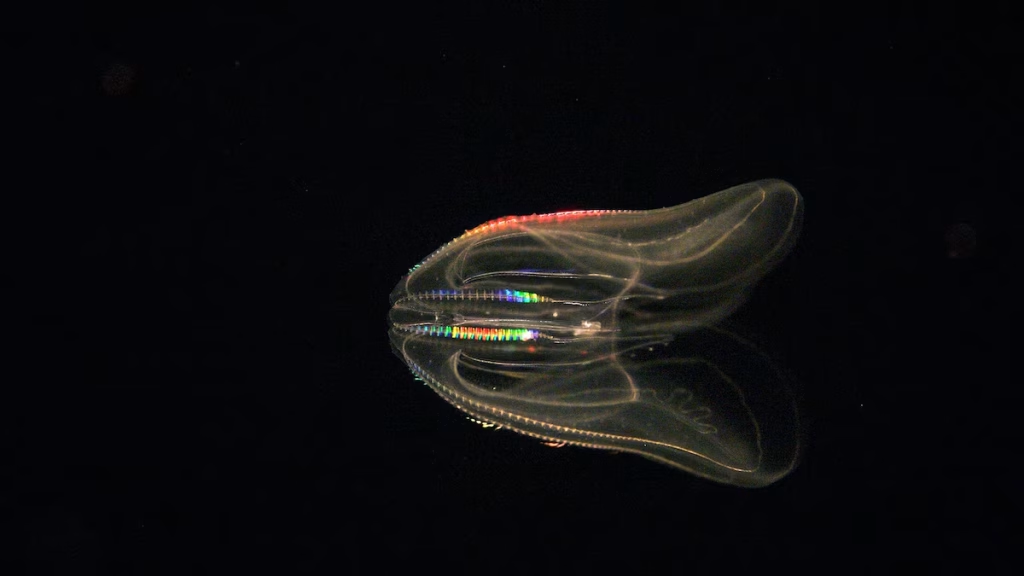
Bioluminescence is the production of light by living organisms through a chemical reaction. Unlike fluorescence or phosphorescence, which require an external light source, is generated internally. This process occurs when a light-emitting molecule, called luciferin, reacts with oxygen in the presence of an enzyme known as luciferase.
The result is the emission of visible light, typically blue or green in marine environments. These wavelengths travel farther in seawater, making them especially effective for communication and survival in the deep ocean.
The Chemistry Behind Living Light
Although the general principle of bioluminescence is similar across species, the specific chemical compounds involved vary widely. Different organisms use distinct forms of luciferin and luciferase, resulting in variations in color, intensity, and duration of light emission.
Some marine organisms can precisely control their light output, producing brief flashes, continuous glows, or rhythmic pulses. This level of control suggests that has evolved as a highly specialized and adaptive trait.
Where Bioluminescence Occurs in the Ocean
Bioluminescence is most common in the open ocean and deep-sea environments, where darkness dominates. Scientists estimate that more than 75 percent of deep-sea organisms are capable of producing light in some form.
However, bioluminescence is not limited to the depths. Coastal waters can glow due to bioluminescent plankton, particularly dinoflagellates, which emit light when disturbed by waves, boats, or swimming animals.
Bioluminescent Plankton: The Ocean’s Sparkle
Among the most familiar examples of marine are dinoflagellates. These microscopic organisms produce brief flashes of light when mechanically stimulated, creating glowing trails in the water.
This response is thought to serve as a defense mechanism, potentially startling predators or attracting larger organisms that prey on the attackers. Such interactions highlight howinfluences behavior even at the smallest scales of the food web.
Deep-Sea Bioluminescent Creatures
The deep ocean hosts an astonishing diversity of bioluminescent life forms. Jellyfish, squid, shrimp, fish, and even some bacteria have evolved light-producing capabilities.
Anglerfish are among the most iconic examples. They use a lure to attract prey in the darkness. Other species employ light for camouflage, communication, or mating displays, demonstrating the versatility of this adaptation.
Counterillumination: Hiding in Plain Sight
One of the most remarkable uses of bioluminescence is counterillumination. Some marine animals emit light from their undersides to match the faint light filtering down from above, effectively erasing their silhouettes.
This strategy helps them avoid detection by predators lurking below. Counterillumination illustrates how bioluminescence can function as a form of active camouflage, blending biology with optical physics.
Communication Through Light
In the vast and dark ocean, visual signals can be more effective than sound or chemical cues. Many species use to communicate with others of their kind.
Specific flash patterns, colors, or intensities may signal readiness to mate, establish territory, or coordinate group behavior. These light-based interactions form a hidden language of the deep sea.
Defense Mechanisms and Predator Avoidance
Bioluminescence also serves as a powerful defensive tool. Some organisms release clouds of glowing particles to confuse predators, creating a visual distraction that allows them to escape.
Others use sudden flashes of light to startle attackers or expose them to larger predators. These strategies reveal how bioluminescence contributes to survival in high-risk environments.
Bioluminescence and the Marine Food Web
Light production influences predator-prey relationships throughout marine food webs. By attracting prey, deterring predators, or facilitating communication, shapes feeding strategies and energy transfer.
Understanding these interactions is essential for appreciating how Bioluminescence: Nature’s Underwater Light Shows Explained fits into broader ecological processes.

Evolutionary Origins of Bioluminescence
Bioluminescence has evolved independently multiple times across different evolutionary lineages. This convergence suggests strong selective advantages associated with light production.
Scientists believe early may have originated as a byproduct of metabolic processes, later becoming refined into a functional trait through natural selection.
Human Encounters With Bioluminescence
For centuries, sailors and coastal communities have reported glowing seas and mysterious lights beneath the waves. Today, these phenomena are better understood through scientific research.
Modern technologies, including remotely operated vehicles and deep-sea submersibles, have allowed scientists to observe } in its natural context, revealing behaviors never seen before.
Scientific Applications and Research
Beyond its ecological significance, has practical applications in science and medicine. Bioluminescent proteins are widely used as markers in genetic research, medical diagnostics, and environmental monitoring.
The discovery and study of these proteins have led to major advances in molecular biology, demonstrating how natural phenomena can inspire technological innovation.
Bioluminescence and Climate Change
Environmental changes, including ocean warming and pollution, may affect bioluminescent organisms. Shifts in plankton populations, for example, can alter the frequency and intensity of coastal bioluminescent events.
Monitoring bioluminescence patterns may provide valuable insights into changing ocean conditions and ecosystem health.
Challenges in Studying Bioluminescence
Studying bioluminescence presents unique challenges. Many bioluminescent species are fragile, difficult to collect, or live in extreme environments.
Advances in imaging technology and non-invasive observation techniques are helping scientists overcome these obstacles and deepen their understanding of this phenomenon.
What Bioluminescence Teaches Us About Life in the Ocean
The study of Bioluminescence: Nature’s Underwater Light Shows Explained reveals the extraordinary adaptability of life in the ocean. It highlights how organisms have evolved innovative solutions to survive and thrive in darkness.
These insights broaden our understanding of biodiversity and the intricate relationships that define marine ecosystems.
The Future of Bioluminescence Research
As exploration of the deep sea continues, scientists expect to discover new bioluminescent species and mechanisms. Each discovery has the potential to reshape our understanding of marine biology and evolution.
Future research may also uncover new applications for bioluminescent systems in technology, medicine, and environmental science.
Conclusion
Bioluminescence transforms the ocean into a realm of living light, revealing the creativity of evolution in one of Earth’s most challenging environments. Far from being mere spectacle, these underwater light shows play essential roles in communication, defense, and survival.
By studying bioluminescence, scientists gain insight into the hidden dynamics of marine ecosystems and the remarkable strategies life employs to endure in darkness. The glowing ocean serves as a reminder that even in the absence of sunlight, nature finds ways to shine.
Si quieres conocer otros artículos parecidos a Bioluminescence: Nature’s Underwater Light Shows Explained puedes visitar la categoría Marine Biology.
Comprehensive Guide to Recently Discovered Vaccines

The Role of AI in Scientific Research: Revolutionizing the Future

The Skeleton Hand: Anatomy, Functions, and Scientific Curiositie

Artificial intelligence applied: the most surprising examples

Is Psychology a Science? Unraveling the Debate in 2024

Body Language News: What Recent Studies Reveal About Nonverbal Communication